
 Customizing a food trailer means fitting every part of a mobile kitchen to one menu, one workflow, and one set of local codes.
Done right, the trailer serves faster, passes inspection the first time, and holds up to years of daily use.
The decisions that get you there follow a rough order, and the earliest ones carry the most weight.
Key Takeaways
- Your menu drives every other decision. Equipment, power, water, and ventilation all follow from what you plan to cook.
- Trailer size is a trade-off, not an upgrade. More space means more capacity but higher cost and harder towing and parking.
- The layout should follow the path food takes, from prep to cooking to the service window, with no cross-traffic.
- Commercial, NSF-certified equipment is what passes inspection and survives daily service. Residential gear does not.
- Health codes are set locally and vary by county, so the build has to be designed around the strictest reviewer you will face.
- A custom trailer from a builder typically starts around $42,000 and takes 4 to 10 weeks, depending on equipment and complexity.
Start With the Menu, Not the Trailer
Before you look at a single trailer, lock in your menu. Every downstream choice, from size to equipment to power to plumbing, is dictated by what you plan to cook.
A fryer-and-griddle menu needs a Type I hood, fire suppression, a heavy power draw, and a way to handle grease. A coffee-and-pastry menu needs almost none of that but leans hard on refrigeration and water. Those are two completely different builds, and the difference traces back to the menu alone.
Committing to the menu first prevents the most expensive mistake in mobile food: building a kitchen the menu outgrows in six months, or one that is far heavier and more complex than the concept ever needed. If you are still refining what you will sell, work that out before you spec the trailer, not after. A menu built for speed and margin makes every following decision easier.
Match the Trailer Size to Your Menu and Volume
Trailer size is a trade-off between capacity and mobility, not a straight upgrade. We build custom food trailers from 10 to 24 feet, and the right length depends on your equipment list and realistic volume, not on wanting the biggest unit on the lot.
A 10 to 14 foot trailer suits a single operator running a focused menu like coffee, desserts, or tacos. It tows behind a half-ton truck and fits into tight event spaces and small lots.
A 16 to 18 foot trailer gives you room for a full cook line plus prep space and two or three staff without anyone tripping over each other.
A 20 to 24 foot trailer handles high volume and catering, with room for multiple cook stations, but it needs a capable tow vehicle and a larger footprint wherever you park.
Size cuts both ways. A bigger trailer costs more to build, tow, and store, while an undersized one caps your throughput on your busiest day of the year, which is the day that matters most.
Lay Out the Kitchen Around How Food Moves
The layout should follow the path a single order takes, from prep to cooking to the service window, with staff never crossing each other’s lane. In a space this tight, workflow is the difference between serving quickly and jamming up at the window during a rush.
Map the line so prep, cooking, plating, and handoff sit in sequence, in the direction food actually travels. Place refrigeration next to or under the cook so nobody walks the length of the trailer mid-service. Keep the hand sink separate and easy to reach.
Layout and compliance get designed together, because health codes force a physical separation between raw and ready-to-eat zones. A good plan solves both at once.
Choose Commercial Equipment That Earns Its Space
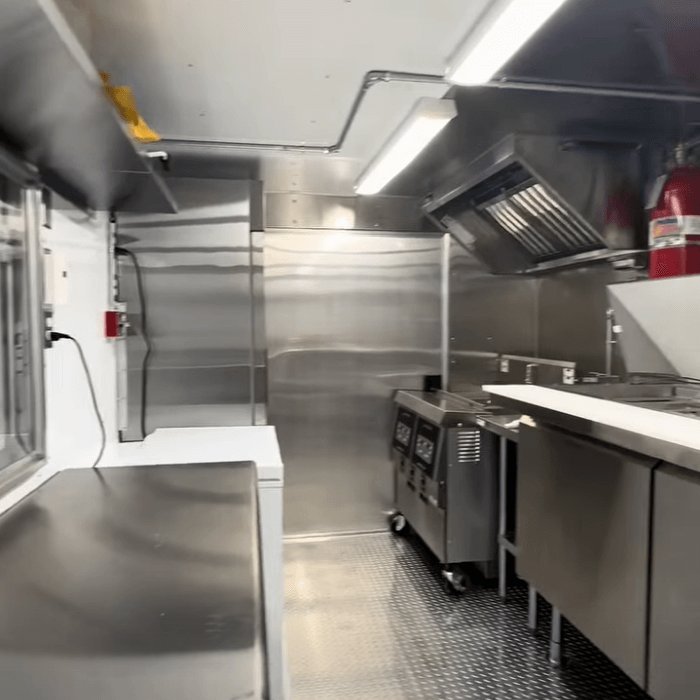
Every appliance in a food trailer should be commercial-grade, NSF-certified, and sized to both your volume and the space it takes up. Residential equipment fails inspection and wears out fast under daily commercial use.
We build with ETL and NSF-certified commercial equipment for exactly that reason. It survives the use, and it satisfies the inspector.
Right-Sizing Equipment Matters as Much as Quality
An oversized fryer eats counter space and power you could put toward something else.
Equipment weight and placement also affect how the loaded trailer tows, so balance is part of the spec, not an afterthought.
And the gas-versus-electric choice on each appliance ripples downstream into your propane and power needs, so it needs confirmation earlier in the build process.
Build Out the Systems That Keep It Running
The systems behind the walls, meaning power, water, gas, and ventilation, are what turn a shell into a working kitchen. Each one has to be sized for the equipment it feeds.
Every trailer we build comes standard with:
- A hood and exhaust system with fire suppression
- Full plumbing with fresh and grey water tanks and a water heater
- A three-compartment sink plus a separate hand sink
- A 12,000-watt generator
- A 100-pound propane tank
- A 50-amp shore power connection
The reasoning behind each is practical.
- Ventilation is non-negotiable over fryers and grills.
- Undersized power trips breakers in the middle of service.
- Grey water capacity sets how long you can run before you have to stop and dump.
Getting these right is most of what separates a trailer that works from one that fights you, and it is the core of how a build comes together.
Design for the Health Inspector From Day One
Health and fire codes for mobile kitchens are set locally and vary by county, so a food trailer has to be designed around the rules of the jurisdiction where you will operate. Retrofitting a finished trailer to pass inspection is slow and expensive.
Get the plan-review checklist from your local health department before construction starts, not after. Requirements commonly cover:
- sink counts
- water capacity
- Ventilation
- fire suppression
- interior finish materials
Most jurisdictions base their rules on the FDA Food Code, which is a useful baseline to understand even before you pull your local checklist.
Building to the strictest reviewer you expect to face keeps you legal across more locations. Launching across Maryland’s county-by-county process, for example, means clearing separate health departments, which is why we build with documentation those reviewers can actually sign off on.

Wrap, Windows, and the Look Customers See
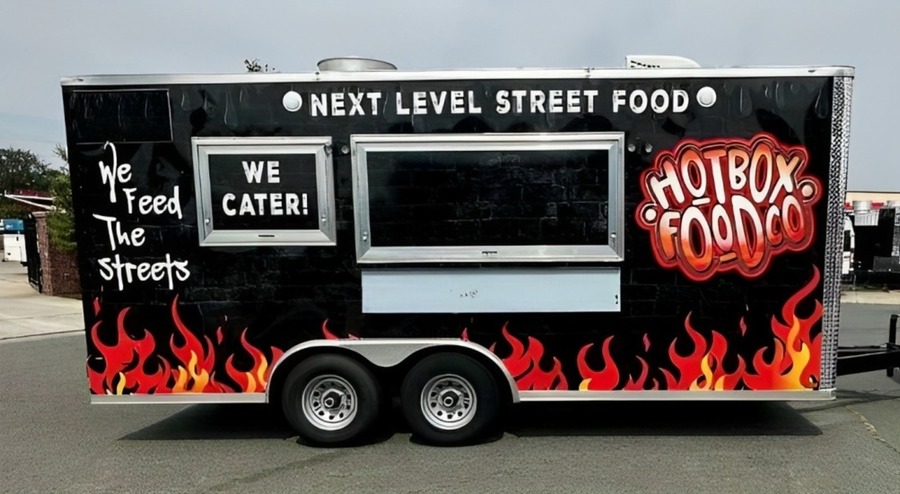
The exterior is the first thing a customer reads, and on a trailer it does the job a storefront does for a restaurant. The wrap, the service window, the lighting, and the menu board together decide whether people stop or keep walking.
You can choose a full or partial wrap depending on budget and design. Place the service window where your line actually ends, so handoff lands at the front instead of forcing a cook to backtrack. Add lit menu boards if you work night events, where an unreadable board costs you sales in the dark.
Consistency ties it together. The trailer, your signage, and your social presence should look like one brand that gets people in line, not three different businesses.
Understand What Drives Cost and Timeline
Equipment selection is the single biggest driver of what a custom food trailer costs. A minimal build starts around $42,000, and the number climbs with every appliance, system, and finish you add.
A coffee or dessert trailer is far cheaper to outfit than a full cook line with fryers, griddles, and heavy refrigeration. That gap is almost entirely equipment.
The timeline follows the same logic. A straightforward build runs about 4 to 6 weeks, while a complex trailer with extensive custom work can take 8 to 10. Knowing where your build lands helps you plan your launch and your cash flow.
It is worth reading up on managing your build cost and your options for financing a build before you commit to a spec.
Custom Build or Prebuilt Plan?
Not every operator needs a fully bespoke trailer. A prebuilt floor plan is often faster and cheaper, while a full custom build makes sense when your menu or workflow needs something a standard plan cannot give you.
Prebuilt plans are proven layouts that move quickly through production. Full custom is worth the added time when you run unusual equipment, serve a tight niche, or have a specific workflow that a stock plan would fight.
Conclusion: Bringing It Together
A custom food trailer is really a chain of dependent decisions, and the menu you commit to at the start sets the ceiling for everything after it. Get the menu, size, and layout right, and the equipment, systems, and code fall into place around them.
If you are weighing a build, start by writing out your full menu and describing your busiest realistic day. Bring both to a builder to spec and price a custom trailer. That one document answers most of the questions a real build starts with.
Frequently Asked Questions
How much does it cost to customize a food trailer?
A custom build typically starts around $42,000 for a minimal setup and rises from there based on the equipment, systems, and finishes you choose. Cooking equipment is usually the biggest single factor. A coffee or dessert trailer costs noticeably less to outfit than a full cook line with fryers, griddles, and heavy refrigeration.
How long does it take to build a custom food trailer?
A straightforward build usually takes about 4 to 6 weeks, while a more complex trailer with extensive equipment and custom work can run 8 to 10 weeks. The timeline depends mostly on the scope of the kitchen and how much of the design is bespoke versus based on a proven plan.
What size food trailer do I need?
Size depends on your menu and expected volume, not on wanting the largest unit. A 10 to 14 foot trailer suits a single operator with a focused menu, 16 to 18 feet fits a full menu with a small crew, and 20 to 24 feet handles high volume and catering. Keep in mind that a bigger trailer costs more to build, tow, and store.
Do I need special permits to operate a food trailer?
Yes. Mobile food operations are regulated locally, usually at the county level, and requirements cover health inspection, fire safety, and sometimes a separate commissary kitchen. Get the plan-review checklist from your local health department before you build so the trailer is designed to pass the first time.
What comes standard in a custom food trailer?
Our standard builds include a hood and exhaust system with fire suppression, full plumbing with fresh and grey water tanks and a water heater, a three-compartment sink plus a hand sink, a 12,000-watt generator, a 100-pound propane tank, and a 50-amp shore power connection. From there, the cooking and refrigeration equipment is customized to your menu.