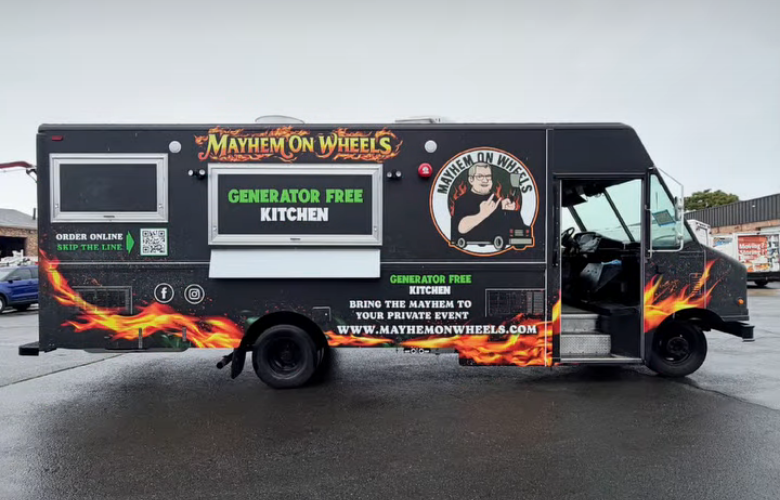

A battery-powered food truck runs its kitchen on a stored energy system instead of an on-board gas generator, so service stays quiet, clean, and off the daily fuel bill.
We build these regularly, and what started as a novelty is now something readily available for almost any build.
The setup fits some menus cleanly and pushes others toward a hybrid build, and which camp you fall into comes down to how you cook and where you park.
Key Takeaways
- A battery-powered food truck replaces the gas generator with a battery bank, charged from shore power and, on some builds, rooftop solar.
- Battery systems run refrigeration, lighting, point-of-sale, ventilation, and low-heat equipment like coffee and cold prep cleanly and silently.
- High-heat cooking such as flat-top griddles and deep fryers draws far more power than a battery bank supplies efficiently, so most builds keep propane for the hot line.
- A battery system is sized around two numbers: total energy used across a service, and the peak surge when your heaviest equipment cycles on.
- The main reasons operators switch are noise, exhaust, recurring fuel and maintenance cost, and venues that restrict or ban generators.
- California’s AB 1346 requires new portable generators sold in the state to meet zero-emission standards by model year 2028, part of a broader move away from small gas engines.
What “Battery-Powered” Means on a Food Truck
A battery-powered food truck stores electricity in an onboard battery bank and delivers it through an inverter, with no fuel-burning generator running during service. The battery charges between shifts, most often by plugging into shore power overnight, and on some builds a rooftop solar array tops it up during the day.
That setup is what removes the generator from the picture. Everything the kitchen needs to run electrically pulls from the bank instead of from a gas engine parked outside the service window.
Battery-Powered Kitchen vs. Electric Vehicle
A battery-powered food truck refers to how the kitchen gets its electricity, not how the truck drives. The vehicle can run a conventional engine to get from the commissary to the curb while the galley behind it runs silently off the battery.
An electric-drivetrain vehicle and a battery-powered kitchen are separate builds at very different price points, and most operators who ask us for “electric” want the quiet kitchen, not the electric motor.
What Runs on Battery, and What Needs Propane
A battery bank runs steady, moderate electrical loads efficiently and struggles with sustained high-heat cooking. That division shapes the rest of the build.
Battery:
- Refrigeration
- Freezers
- Lighting
- Ventilation fans
- Point-of-sale
- Water pumps
- Low-heat equipment like coffee machines and blenders
Propane:
- Flat-top griddles
- Deep fryers
- Charbroilers
Food Truck and Trailer Types That Fit a Battery Build Best
A battery build fits best when the menu already runs on refrigeration, cold prep, and low-heat electric equipment instead of a high-heat cooking line. These concepts get the most out of the setup with the smallest battery bank:
- Coffee and espresso: espresso machines, grinders, and refrigeration are all electric loads a battery handles cleanly, and the quiet operation suits the café feel customers expect.
- Frozen desserts: ice cream, gelato, and shaved ice run on freezers and soft-serve machines that are electrical to begin with, so a battery adds almost no new demand.
- Juice and smoothies: blenders and refrigeration carry the entire menu, including açaí bowls and cold-pressed juice, with no cooking to force a propane line.
- Cold-prep menus: poke bowls, salads, and sandwiches lean on refrigeration and display cases rather than heat, which keeps the electrical load steady and predictable.
- Beverage and bar trailers: taps, refrigeration, and lighting make up the whole load, which a battery covers through a full event without a generator running behind the bar.
- Bakery and pastry: when the baking happens off-site, the trailer mostly needs refrigeration, display, and point-of-sale, all easy loads. On-board electric ovens raise the draw and usually call for a larger bank.
Hot-line concepts like burgers, tacos, and fried food still work as a hybrid build, with propane for the cooking and battery for everything else.
Is a Battery-Powered Build Right for Your Menu?
A battery-powered build fits best when your menu leans electric and your bookings reward a quiet, clean setup. It fits least when you run a high-volume hot line and rarely have shore power. Menu is the biggest factor, and the concepts above show where most builds land.
Two more things decide whether the setup works for you:
- Your route: regular shore power for overnight charging makes the system easy to live with. Long shifts far from a hookup raise the capacity you need, and the cost with it.
- Your budget: a battery system costs more upfront and earns it back through lower fuel and maintenance, plus access to events that turn generators away.
Because these interact with the menu, we plan the power system and the layout of a custom food truck together rather than as separate decisions.
Why Operators Are Moving Away From Generators
Operators move away from generators for reasons that show up on every shift, not just on a spec sheet:
- Noise: a portable generator typically runs at 80 to 100 decibels, about the level of a running lawn mower, for the length of your service, right where customers order and the crew works.
- Exhaust: a gas generator puts fumes and smell into the air next to the food you are selling.
- Ongoing cost: fuel is a daily expense, and generators need oil changes, filters, and repairs that a sealed lithium bank does not.
- Venue access: a growing number of festivals, markets, corporate campuses, and indoor venues limit or ban generators, and some of the best-paying bookings are the strictest.
How a Battery System Is Sized
A battery system is sized around two numbers: how much energy you use across a full service, and the peak load at the moment your heaviest equipment switches on. Both have to be right, because they fail in different ways.
Total Energy Sets the Size of the Bank
Refrigeration runs continuously, and lighting and the point-of-sale run all day, so those steady loads add up to the kilowatt-hours the bank has to hold from open to close. Undersize it and the truck runs out before the shift ends.
Peak Load Sets the Size of the Inverter
Every time a compressor starts, it pulls a brief surge well above its running draw, and a system built only for average use sags when refrigeration, lights, and the POS all pull at once. Matching the inverter to that peak, not just the average, is the part most do-it-yourself builds get wrong.
Across both numbers, the most common mistake we see is a bank sized down to hit a price, then asked to carry refrigeration and a cooking appliance it was never going to support. Bolting a bigger battery on later rarely fixes it. The system has to be sized to the menu from the start.
How a Battery System Charges
A battery bank charges three ways, and a good build uses more than one.
Shore power is the primary path, an overnight or between-shift plug-in on a standard 240V connection that refills the bank fastest.
The vehicle’s alternator can top the bank up while you drive to your spot, so you arrive with more charge than you left with.
Rooftop solar adds runtime through the day, but contributes less than most operators expect. A rooftop array around 1,000 to 1,200 watts might offset a couple of hours of refrigeration on a sunny day. It stretches how long the bank lasts between charges. It will not run your griddle.
Conclusion
A battery-powered food truck comes down to one fit: matching the power system to how you cook and where you park.
Electric-leaning menus with regular shore power get the most out of it, while high-heat kitchens land on a hybrid that keeps propane for cooking and runs everything else in silence. Getting the sizing and the split right is the whole job, and it is worth slowing down for.
If you are working through a build, our design and build resources cover the decisions that shape it, and we are glad to talk through what yours would take.
Frequently Asked Questions
Can a food truck run without a generator?
Yes. A battery bank paired with an inverter can power a truck’s electrical system, charged from shore power and sometimes topped up by rooftop solar or the vehicle’s alternator. Many operators run generator-free this way, especially on menus that do not depend on high-heat electric cooking.
How long does a battery-powered food truck last on a charge?
It depends on the size of the battery bank and how much power your equipment draws. A system sized for lighter loads can cover a full service day and recharge overnight on shore power. Heavier loads shorten runtime and call for a larger bank.
Can you cook on a battery-powered food truck?
Yes, with the right setup. Electric appliances like induction burners, coffee machines, and blenders run well off a battery. High-heat cooking such as griddles and fryers draws so much power that most builds keep propane for the hot line and run everything else on battery.
Is a battery system cheaper than a generator?
Not upfront. A battery build costs more to install than a generator, but it has no fuel bill and far less maintenance, and it keeps you eligible for events that restrict gas power. Whether it saves money overall depends on your route, your hours, and your menu.
Can a battery-powered food truck work events that ban generators?
Yes, and that is one of the main reasons operators build them. A battery-powered truck runs with no engine noise or exhaust, so it can take bookings at indoor venues, corporate campuses, and events that restrict or prohibit generators. Those tend to be among the better-paying bookings.
Are gas generators being banned for food trucks?
There is no blanket national ban. California is phasing out the sale of new gas-powered portable generators, with a zero-emission standard for that category by model year 2028. Separately, many events and venues already restrict or prohibit generator use regardless of state law.